
Therapeutic Ukulele and Guitar- Instruction and Performance


All Ages Welcome, and Beginners Too!
Robert Krout is a Board Certified Music Therapist (MT-BC). Living, teaching, and performing from his base in Galveston, Texas,
Robert‘a passion is sharing aloha and the therapeutic benefits music instruction and performance. He earned his Bachelor of Music Education degree from Ithaca College, and Master of Arts, Master of Education, and
Robert Krout is a Board Certified Music Therapist (MT-BC). Living, teaching, and performing from his base in Galveston, Texas,
Robert‘a passion is sharing aloha and the therapeutic benefits music instruction and performance. He earned his Bachelor of Music Education degree from Ithaca College, and Master of Arts, Master of Education, and Doctor of Education degrees in music therapy, special education, and music education from Columbia University. He is Professor Emeritus in the Meadows School of the Arts at SMU in Dallas. Robert’s album “Songs From a Music Therapist” can be streamed on Spotify/Apple/Amazon Music. He has been interviewed about his songwriting and uses of guitar in education and therapy by Grammy, Acoustic Guitar, and Premier Guitar magazines. Robert has also published a number of guitar instruction books, including “Therapeutic Guitar” published by Alfred. Robert currently teaches ukulele courses for the Osher Lifelong Learning Institute at the University of Texas Medical Branch. He founded the Galveston Ukulele Society in 2016.

Therapeutic Ukulele
Therapeutic ukulele is the learning, playing, and sharing of music on the ukulele to enhance the quality of life of the player, listener, and community through a spirit of shared aloha (Krout).
Therapeutic Guitar
Therapeutic Guitar is an innovative method that was designed and extensively field tested for students with unique learning and lifestyle needs. The songs and therapeutic activities designed to accompany them make this method a unique experience (Krout).
Galveston Ukulele Society
Galveston Ukulele Society
Galveston Ukulele Society
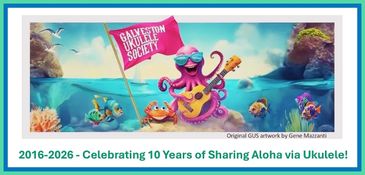
The Galveston Ukulele Society (GUS) was founded in 2016 to bring together players of all ages and abilities to share aloha and their love of the ukulele. We meet regularly and perform at many events on Galveston Island and the surrounding areas. Our octopus mascot GUS was designed by our friend Gene Mazzanti of the Plucking Strummers Uk
The Galveston Ukulele Society (GUS) was founded in 2016 to bring together players of all ages and abilities to share aloha and their love of the ukulele. We meet regularly and perform at many events on Galveston Island and the surrounding areas. Our octopus mascot GUS was designed by our friend Gene Mazzanti of the Plucking Strummers Ukulele Club of Los Angeles. Please like and follow us on Facebook! https://www.facebook.com/GalvestonUkuleleSociety?
History of the Ukulele & Aloha, w/ 5 Classic Songs

Background Info About Hawaii, Birthplace of the Ukulele
The Hawaiian islands were first settled as early as 400 AD by Polynesians traveling long distances by water. British explorer Captain James Cook's name for the Hawaiian Islands, the Sandwich Islands, was widely accepted and commonly used by foreigners and foreign governments for well over fifty years after his arrival on January 18, 1778. Cook named the islands for his patron, John Montagu, the Fourth Earl of Sandwich. On a tasty side note, the origin of the word 'sandwich' for an item of food may have originated from a story about John Montagu asking for a piece of meat between two pieces of bread. He didn't really 'invent' the sandwich but he may have made it popular. Back to our story.
A great warrior, diplomat and leader, King Kamehameha I united the Hawaiian Islands into one royal kingdom in 1810 after years of conflict. Hawaiian legend prophesied that a light in the sky with feathers like a bird would signal the birth of a great chief. Historians believe Kamehameha was born in 1758, the year Halley’s comet passed over Hawaii. On October 8, 1840, Hawaii had its first constitution, and a significant change was made regarding the name. The name Hawaiian Islands is repeated three times in the first constitution and the name Sandwich Islands never again appears in official documents. So, before it became the 50th U.S. state in August of 1959, it was a unified kingdom, next an independent republic, and then a US territory.
Spellings and Pronunciation of Hawaii and Ukulele
Hawaii - Historical spellings of Hawaii often include the punctuation mark called an 'okina (e.g. Hawai'i), which is also used by some ukulele manufacturers. The 'okina is a phonemic glottal stop in many Polynesian languages and is still used in pronunciation by many Hawaiian people.I have the more common and contemporary spelling of Hawaii/Hawaiian without the 'okina. This is how it is spelled in the Act to Provide for the Admission of the State of Hawaii into the Union of 1959. For pronunciation, Hawaiians may pronounce the w as a v.
Ukulele - Occasionally you will see it spelled 'ukulele, and this spelling is also used by some Hawaiian based manufacturers such as Kanile’a 'Ukulele. I prefer to the use the more common spelling of ukulele without the 'okina. This is the spelling used by many ukulele publications and sources (e.g. Ukulele Magazine). It is most accurately pronounced "oo-koo-le-le” or “oo-koo-leh-leh” in Hawaiian. I prefer that pronunciation and recommend not using the oft-heard Americanization “yoo-ka-lay-lee”. When using a spoken abbreviation, I suggest saying “ook” and not “yuke”.
Origins and Rising Popularity from 1879 to Today
The ukulele came into existence as a hybrid outgrowth of several European fretted folk instruments. These included the four-string Portuguese braguinha, also known as the machête or the machête de Braga. This and similar folk instruments sailed from the Portuguese island of Madeira with indentured emigrants traveling to Hawaii in 1879 to work in the sugar cane plantations. The emigrants played the instruments during the long sea voyage for entertainment and once ashore in celebration of a successful crossing.
Amongst the Portuguese emigrants were several woodworkers, including Manuel Nunes, Jose do Espírito Santo, and Augusto Dias. After completing their indentured time working in the sugar cane plantations, all three started building instruments (including the machête) in Honolulu. They combined elements of the machête and other popular Portuguese folk instruments such as the five-stringed rajāo and four-stringed cavaquinho. These woodworkers also used the available native Hawaiian woods such as koa, and gut strings as opposed to metal ones used on the Portuguese instruments. Finally, they utilized the tuning of the top four of the five strings of the rajāo. The earliest ukuleles were similar in size to what we would today call a soprano ukulele. This was the approximate size and scale length of the machête.
The rapid acceptance of the ukulele in Hawaii was due in part to the patronage of the royal family. King David Kalakaua, who reigned from early 1874 until his death in early 1891, was a composer and often played his ukulele in public. This helped to make the instrument fashionable. His brother Prince Leleiohoku, and sisters Princess Likelike and the future Queen Lili’uokalani all played ukulele.
The word ukulele itself has several possible origins. One is that it is a compound with two parts, being “uku” (Hawaiian for flea) and “lele” (Hawaiian for jumping). Another possible origin has been accredited to Queen Lili‘uokalani, who ruled Hawaii between January 1891 and 1893. She used a more poetic version of the term “uku” and interpreted the instrument as a gift from afar. A third theory postulates that another definition of “uku” is small, and this word may have been combined with that of Hawaiian’s previous folk instrument of choice, the ukeke (sometimes referred to as a mouth bow).
By the early 20th century, ukuleles were being commercially produced in growing numbers in Honolulu. The popularity of the ukulele also flourished on the mainland U.S. following the Panama-Pacific International Exposition, held in San Francisco in 1915. There at the Hawaiian Pavilion over the course of 10 months, a Hawaiian quintet featuring ukuleles played to hundreds of thousands of attendees. Following that exposition, ukuleles were exported to the mainland en masse, and ukulele manufacturing also began in earnest. The ukulele manufacturer Kamaka began production in Honolulu in 1916, and is still family owned and operated.
Since that time the ukulele range has grown to many instruments of varying sizes, shapes, features, and string configurations. The instrument has experienced various waves of popularity, and has been featured in popular music for well over a century. The instrument became popular in the early recording and film industries, as well as sheet music publishing during the rise of Tin Pan Alley in New York City. These song writers and music publishers dominated the popular music scene in the late 19th century and early 20th century. Popular Hawaiian-themed and ukulele-centered songs included My Honolulu Ukulele Baby, I Can Hear the Ukuleles Calling Me, and many others.
The instrument maintained popularity all the through the Great Depression, as ukuleles were affordable. For example, by the mid 1930s the Harmony Company, which was then the largest manufacturer of stringed instruments in the U.S., was selling dozens of different lines of ukuleles. During World War II, troops took ukuleles with them overseas for leisure and entertainment, and the US War Department had ukulele kits shipped to Allied bases in war zones. These included instruments, simple instructions on how to play, and chord charts for easy popular and folk songs.There was a colorful cowboy ukulele fad during the 1940s and 1950s when western films and later TV shows were in vogue. The ukulele reached a peak of popularity in the 1950s to early 1960s on TV and in movies ranging from westerns to Hawaii-themed films. Arthur Godfrey strummed the uke in a Hawaiian shirt in his TV series Arthur Godfrey and His Ukulele, Bing Crosby crooned and plucked one, and Elvis Presley played ukulele in his hit film Blue Hawaii. In 1968, Tiny Tim’s rendition of the 1929 song Tiptoe Through the Tulips was a huge hit. A year later, B.J. Thomas's song Raindrops Keep Fallin' on My Head was featured in the film Butch Cassidy and the Sundance Kid, which earned an Oscar for song of the year.
More contemporary examples abound. For example, Hawaiian performer Israel Kamakawiwo’ole’s (commonly known as Bruddah Iz, or simply Iz) adapted version of Somewhere Over The Rainbow has been described as one of the most popular songs of all time for ukulele. Train’s 2009 hit Hey Soul Sister features and begins with a tenor ukulele. Actor Dwayne (The Rock) Johnson strummed and sang the classic What a Wonderful World in the 2012 movie Journey 2: The Mysterious Island. Australian James Gabriel Keogh, better known professionally as Vance Joy, released his ukulele-based indie-folk rock hit Riptide on his 2013 debut recording. In 2015, Pearl Jam front-man Eddie Vedder won a Grammy with his album titled Ukulele Songs, and in 2016, the TV show America’s Got Talent contest was won by then 12-year-old singer-songwriter Grace Vanderwaal, who accompanied herself on ukulele. Ukulele sales have continued to increase in recent years, and according to a 2021 NAMM report, show no sign of slowing. As proclaimed by Jähnichen (2017), “The history of the ukulele is today”.
The Spirit and Essence of Aloha
Aloha refers to a spirit of love, connectedness, and sharing joy. It serves as a greeting or welcome, as well as a farewell or goodbye. Another use is as an expression of love and affection. Aloha has been described as a way of life in Hawaiian culture, and an emphasis in the community is on spreading the aloha spirit. The word itself can be broken into two parts, “alo” meaning “presence” or “share”, and “ha” describing “breath or essence of life”. The spirit of aloha is so important that a state statute requires that citizens and government officials must conduct themselves with aloha. In Hawaiian culture, the ukulele is central to sharing aloha. According to Ukulele Project Hawaii, all schools teach ukulele in the 4thgrade, and almost all homes have a ukulele. The ukulele is featured at ohana (family) gatherings, church, and many community events.
About Written and Spoken Hawaiian
The Hawaiian Islands were first settled as early as 400 C.E., when Polynesians from the Marquesas Islands, 2000 miles away, traveled to Hawaii's Big Island in canoes. The first language spoken in Hawaii was the closely-related Polynesian language Marquesan. After other Polynesians began to arrive in Hawaii, the Hawaiian language began to develop into its modern form. Eventually, the language became ‘Ōlelo Hawai’i, the Hawaiian Language. The varieties spoken on each island differed slightly from each other, and it was not until the Hawaiian alphabet was developed that the language became standardized across the islands.
Before Captain Cook's arrival in Hawaii in 1778, Hawaiian was strictly an oral language. Cook and his men recorded the Hawaiian language for the first time in 1778. When the first missionaries arrived in Hawaii in 1820, they converted the oral Hawaiian language to a written language so that they were able to convey the messages of the Bible to the Hawaiian people. By 1826, the missionaries had created a Hawaiian alphabet. King Kamehameha III established the first Hawaiian-language constitution in 1839 and 1840.
Pronunciation
Pronunciation rules have few exceptions, and the alphabet has only one symbol for each sound. Hawaiian uses only 13 letters (including the ‘okina)
- Consonants (with W exceptions) are as in English.
Inside words, W can sound like V
- P and k have a softer sound with less aspiration
- The glottal stop ( ‘ ) ‘okina is a short sound break in the word
Vowels are pronounced the same way every time.
A macron ( ¯ ) over a vowel extends the sound.
o a makes a short “ah” sound like the a in “above”
o e makes an “eh” sound like the e in “let”
o i makes an “e” sound like the e in “easy”
o o makes a short “oh” sound like the o in “pole”
o u makes an “oo” sound like the oo in “moo”
Note - Hawaiian is often written in all lowercase
Five Classic Songs of Hawaii
Aloha Oe (Farewell to You)
Words and music by Queen (then Princess) Liliʻuokalani, 1878
Proudly swept the rain cloud by the cliffs
As it glided through the trees
It seems to be following the liku, the ʻahihi lehua of the vale
Aloha ʻoe, aloha ʻoe, e ke onaona noho ika lipo
(Farewell to thee, farewell to thee,
the charming one who dwells in the shaded bowers)
One fond embrace, before I now depart, until we meet again
Sweet memories come back to me
Bringing fresh remembrances of the past
Dearest one, yes, you are mine own
From you, true love shall never depart
Aloha ʻoe, aloha ʻoe, e ke onaona noho ika lipo
One fond embrace, before I now depart, until we meet again
I have seen and watched your loveliness, the sweet rose of Maunawili
And 'tis there the birds of love dwell, and sip the honey from your lips
Aloha ʻoe, aloha ʻoe, e ke onaona noho ika lipo
One fond embrace, before I now depart, until we meet again
One fond embrace, before I now depart, until we meet again
Pearly Shells – Words W. Edwards/L. Prober
Words set to trad. Hawaiian song ‘Pupu a ‘o ‘Ewa’ 1962
Pearly Shells (pearly shells) from the ocean (from the ocean)
Shining in the sun (shining in the sun),
Covering up the shore (covering up the shore)
When I see them (when I see them)
My heart tells me that I love you
More than all the little pearly shells
For every grain of sand upon the beach, I’ve got a kiss for you
And I've got more left over, for each star, that twinkles in the blue
Pearly Shells (pearly shells) from the ocean (from the ocean)
Shining in the sun (shining in the sun)
Covering up the shore (covering up the shore)
When I see them (when I see them)
My heart tells me that I love you
More than all the little pearly shells
For every grain of sand upon the beach, I’ve got a kiss for you
And I've got more left over, for each star, that twinkles in the blue
Pearly Shells (pearly shells) from the ocean (from the ocean)
Shining in the sun (shining in the sun)
Covering up the shore (covering up the shore)
When I see them (when I see them)
My heart tells me that I love you
More than all the little pearly shells
ore than all the little pearly shells
Tiny Bubbles – Words and music by Leon Pober, 1966
Tiny bubbles (tiny bubbles), in the wine (in the wine)
Make me happy (make me happy), make me feel fine (make me feel fine)
Tiny bubbles (tiny bubbles), make me warm all over
With a feeling that I'm gonna love you till the end of time
So here's to the golden moon, and here's to the silver sea
And mostly here's a toast to you and me
Tiny bubbles (tiny bubbles), in the wine (in the wine)
Make me happy (make me happy), make me feel fine (make me feel fine)
Tiny bubbles (tiny bubbles), make me warm all over
With a feeling that I'm gonna love you till the end of time
So here's to the ginger lei, I give to you today
And here's a kiss that will not fade away
Tiny bubbles (tiny bubbles), in the wine (in the wine)
Make me happy (make me happy), make me feel fine (make me feel fine)
Tiny bubbles (tiny bubbles), make me warm all over
With a feeling that I'm gonna love you till the end of time
With a feeling that I'm gonna love you till the end of time
Island Style – words and music by John Cruz
On the Island, we do it Island style
From the mountain to the ocean, from the windward to the leeward side
On the Island, we do it Island style
From the mountain to the ocean, from the windward to the leeward side
Mama's in the kitchen cooking dinner real nice
Beef stew on the stove, lomi salmon with the ice
We eat and drink and we sing all day
Kanikapila in the old Hawaiian way
On the Island, we do it Island style
From the mountain to the ocean, from the windward to the leeward side
On the Island, we do it Island style
From the mountain to the ocean, from the windward to the leeward side
Yeah, we go grandma's house on the weekend clean yard
If we no go, grandma gotta work hard
You know my grandma, she like the poi real sour
I love my grandma every minute, every hour
On the Island, we do it Island style
From the mountain to the ocean, from the windward to the leeward side
On the Island, we do it Island style
From the mountain to the ocean, from the windward to the leeward side
Over the Rainbow / What a Wonderful World
as sung by Israel Kamakawiwoʻole
Original songwriters Harold Arlen / Edgar Yipsel Harburg
Somewhere over the rainbow, way up high
And the dreams that you dream of once in a lullaby
Somewhere over the rainbow, blue birds fly
And the dreams that you dream of, dreams really do come true
Someday I'll wish upon a star
And wake up where the clouds are far behind me
Where trouble melts like lemon drops
High above the chimney tops, that's where you'll find me
Somewhere over the rainbow, blue birds fly
And the dreams that you dare to,
Why, oh, why can't I?
Well, I see trees of green, and red roses too
I'll watch them bloom for me and you
And I think to myself, what a wonderful world
Well, I see skies of blue, and I see clouds of white
And the brightness of day, I like the dark
And I think to myself, what a wonderful world
The colors of the rainbow, so pretty in the sky
Are also on the faces of people passing by
I see friends shaking hands, saying, "How do you do?",
They're really saying, "I, I love you"
I hear babies cry and I watch them grow, they'll learn much more
Than we'll ever know, and I think to myself
What a wonderful world, world
Someday I'll wish upon a star
And wake up where the clouds are far behind me
Where trouble melts like lemon drops
High above the chimney top, that's where, you'll find me
Somewhere over the rainbow, way up high
And the dream that you dare to
Why, oh, why can't I